
Re-flex-ion
Hellerau European Centre for Arts, Dresden, Germany. 2025
Immersive Audiovisual Performance. 29.4ch audio, 1ch video
830 HOA Room Impulse Response Dataset
11 FOA Outdoor Impulse Response Recordings
32-channel Impulse Response Recordings of Korean and German Architectures


Re-flex-ion is an audiovisual performance project researched and developed through residencies at ZKM Karlsruhe and Hellerau Dresden since September 2025.
This project investigates the acoustic signatures of spaces, ranging from small objects and grand architecture to expansive outdoor areas, treating them as compositional material. By sampling spatial characteristics through surround impulse response/audio recording and 3D scanning, Philip Liu transforms physical spaces into digital audiovisual instruments that bridge the common discrepancies between shape and sound.
Liu regards traditional architecture's function as tuned acoustic instruments, tuned across centuries through iterative calibration at scales vastly exceeding conventional spatiotemporal scales.
He inverts scalar conventions, positioning rooms and enclosures as chordal generators and pattern generators—while small-scale sounding objects serve as signal processors or acoustic effects. This reversal leverages three technical methodologies: surround impulse response capture, acoustical modeling, and physical modeling synthesis.
The work orchestrates over a hundred spatial configurations of four rooms/spaces, each yielding distinct spectral identities. Liu treats both the visual morphology and acoustic behavior of these spaces as plastic material. Reciprocally, miniaturized objects become chambers, functioning as effect processors.
Each audiovisual element manifests an intrinsic shape-sound coherence. Through aural perception—distinct from vision—the notion of time transforms into space, and Liu manipulates the temporal envelope of spatial listening, re-temporalizing the objects and inscribing new semantic layers onto their sonic ontology.


.jpg)

.jpg)
.jpg)
Photo Credit: Klaus Gigga
For centuries, we've put vision on a pedestal, and this was no exception when it came to understanding space.
We trust our eyes above all else when it comes to making sense of the world around us. Walk into any room, and your eyes immediately map out where the funitures are.
But here's what's fascinating: sound tells us stories about space that are hard to capture with our eyes.
When you are in a cathedral, the way your footsteps echo can tell you whether the wall is composed of wood, stone, metal, or a compound of those.
Sound doesn't just give us information – it actuates the body. As propagating energy, it produces visceral and direct affects that bypass our thinking brain.
This is the starting point of my project. I focus especially on creating sacred atmospheres, or sound objects that serve as phenomenological bridges between material and transcendent realms. To explore the world of spaces and objects that create sonic sacredness, I decompose the reverb of spaces and vibrating objects using digital and analog technologies. Then it is sonically explored, and reassembled in new ways, along with the pathways of propagation and structure of sound visualized through light and video. Why do we feel something special from certain sonic gestures and spectra? In my opinion, this is a great time in history to explore such subject.

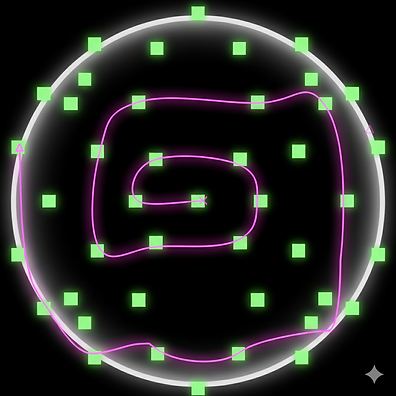
The 29-channel dome speaker array at the Main hall of Hellerau European Center for Arts, and the paths of sound sources (excerpt) moving through the space (yellow/purple).