
Quasi-Spiritual Sonic Nexus
: Sacred Reverb, Aurality of Icons, and Colonization
Kubus Concert Hall, ZKM Karlsruhe, Germany. 2025
Immersive Audiovisual Performance. 43.4ch audio, 1ch video
32-channel Impulse Response Recordings of Korean and German Architectures
Custom light interaction system

Quasi-Spiritual Sonic Nexus explores the spatial information embedded within sounds commonly regarded as possessing sacred qualities.
Since antiquity, across cultures in Asia, Europe, and beyond, the attributes of sound spectra have played a crucial role in catalyzing affective states, functioning as liminal thresholds to spiritual dimensions. These sounds have served not merely as acoustic events but as phenomenological bridges between material and transcendent realms.
In this context, the artist deconstructs the structure of these sacred resonances and vibrating objects using specialized digital techniques, including physical modeling, ray tracing in acoustic room simulation, and transient separation. The deconstructed elements are then recombined in unexpected ways during the performance, with triggers, structures, and pathways visualized through light-based and graphic projections. Through this process, the artist seeks to uncover the universal qualities of sacred sounds and speculate on emerging forms of digital sacredness.
Quasi-Spiritual Sonic Nexus는 신성한 속성을 지닌 것으로 통념화된, 소리에 내재된 공간 정보를 탐구한다.
고대로부터 아시아, 유럽 및 그 너머의 문화권에서 음향 스펙트럼의 속성은 정동적 상태를 촉발하는 데 결정적 역할을 수행해 왔으며, 영적 차원으로의 경계적 문턱으로 기능해 왔다. 이러한 소리들은 단순한 음향적으로 울려퍼지는 소리 그 자체가 아닌, 물질적 영역과 초월적 영역 사이의 현상학적 교량으로서 작용해 왔다. 이러한 맥락에서 작가는 물리적 모델링, 음향 공간 시뮬레이션 맥락에서의 레이 트레이싱, 트랜지언트 분리 등 전문화된 디지털 기법을 사용하여 이러한 신성한 공명과 진동하는 물체들의 구조를 해체한다. 해체된 요소들은 퍼포먼스 중 예기치 않은 방식으로 재결합되며, 트리거, 구조, 경로는 빛 기반 및 그래픽 프로젝션을 통해 가시화된다. 이 과정을 통해 작가는 신성한 소리의 보편적 속성을 발견하고 디지털 신성성의 새로운 형태를 사변한다.
The research+artistic practice project especially employs comparative analysis of soundscapes from Buddhist temples in Korea and their Christian counterparts in Germany, utilizing surround impulse response measurements and field recordings to capture the 'spatiality of sound.' The acoustic documentation of each site employs a comprehensive array of recording technologies, including 32-channel Eigenmike, Ambisonic microphones, contact microphones, bone conduction speakers, etc. The distinctive acoustic properties of the two imply the differences in the auditory cultures of the two cultures and the influence of colonization. Concurrently, the visual topology of these spaces is captured through conventional and drone-based imagery, subsequently processed into three-dimensional models utilizing recent technologies.
For centuries, we've put vision on a pedestal, and this was no exception when it came to understanding space.
We trust our eyes above all else when it comes to making sense of the world around us. Walk into any room, and your eyes immediately map out where the funitures are.
But here's what's fascinating: sound tells us stories about space that are hard to capture with our eyes.
When you are in a cathedral, the way your footsteps echo can tell you whether the wall is composed of wood, stone, metal, or a compound of those.
Sound doesn't just give us information – it actuates the body. As propagating energy, it produces visceral and direct affects that bypass our thinking brain.
This is the starting point of my project. I focus especially on creating sacred atmospheres, or sound objects that serve as phenomenological bridges between material and transcendent realms. To explore the world of spaces and objects that create sonic sacredness, I decompose the reverb of spaces and vibrating objects using digital and analog technologies. Then it is sonically explored, and reassembled in new ways, along with the pathways of propagation and structure of sound visualized through light and video. Why do we feel something special from certain sonic gestures and spectra? In my opinion, this is a great time in history to explore such subject.

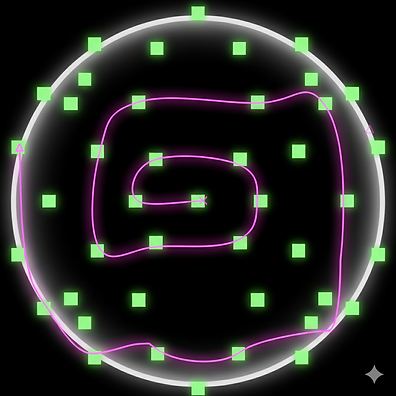
The 43-channel dome speaker array at ZKM Karlsruhe's 'Kubus' (green) and the paths of sound sources (excerpt) moving through the space (yellow/purple).


Artist: Philip Liu
Curatorial Support: Dr. Lea Luka Sikau
Live Sound Reinforcement: Benjamin Miller
Supported by ZKM Karlsruhe
Ver 2.
Hellerau European Centre for Arts, Dresden, Germany. 2025
Immersive Audiovisual Performance. 29.4ch audio, 1ch video
830 HOA Room Impulse Response Dataset
11 FOA Outdoor Impulse Response Recordings
32-channel Impulse Response Recordings of Korean and German Architectures


Re-flex-ion investigates the acoustic signature of space as compositional matter, deploying a dome-shaped multichannel audio system, interactive light emitter-detector system, and videographic projection to render spatialized listening as an aesthetic encounter.
Across diverse cultural geographies—from Asian to European sonic traditions—the resonant properties of built environments and material objects have long structured auditory epistemologies: shaping perceived distance, mediating knowledge transmission, and structuring musical creation and communal exchange.
Liu regards traditional architecture's function as tuned acoustic instruments, tuned across centuries through iterative calibration at scales vastly exceeding conventional spatiotemporal scales.
He inverts scalar conventions, positioning rooms and enclosures as chordal generators and pattern generators—while small-scale sounding objects serve as signal processors or acoustic effects. This reversal leverages three technical methodologies: surround impulse response capture, acoustical modeling, and physical modeling synthesis.
The work orchestrates over a hundred spatial configurations of four rooms/spaces, each yielding distinct spectral identities. Liu treats both the visual morphology and acoustic behavior of these spaces as plastic material. Reciprocally, miniaturized objects become chambers, functioning as effect processors.
Each audiovisual element manifests an intrinsic shape-sound coherence. Through aural perception—distinct from vision—the notion of time transforms into space, and Liu manipulates the temporal envelope of spatial listening, re-temporalizing the objects and inscribing new semantic layers onto their sonic ontology.


.jpg)

.jpg)
.jpg)